Wisdom, sleeping..
A conversation about worldly wisdom
 
Picture
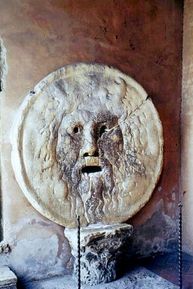
The Mouth of Truth, Rome [1]

There are many truths because there are many honest persons and many beliefs. Truth is not in the "real world", only in the knower and in the speaker, in what they believe and the way they represent it to other people.

Some believe that beliefs are truth only when they are objectively justified; but isn't the acceptable way of justifying a belief too?

Among us, common people*, truth is sincerity – that which is not concealed; something as you understand and accept it to be; presenting things as you are convinced of them to be. That is expressing your truth, the one for which you would risk your hand to get cut in the Mouth of Truth at Santa Maria. To be called truth, your truth must be known.

This deserves respect. Nevertheless, I dread those integrist worshipers in the cult of truth without doubt who would sacrifice everything else, and especially other people, to beliefs. Their truth becomes intolerant faith - The  one Faith, the only one. These people make me count truth among the great sources of man-made evil.

The real-real truth let loose is the devourer of all truth, even itself. When only one truth rules it fathers unavoidable falsity, to survive.

Deadly contagion charges ahead astride truth, like the four horsemen of Apocalypse, whenever there is only one allowed. Other people’s sincere beliefs become errors, madness, inferior ignorance to correct, or worse, wicked lies to punish, crimes of thought.  As Will Durant wrote in his synthesis of the History of Civilisation "certainty is murderous" [1a]

                                                                     *


Sometimes, and quite often, one’s most important truthful belief is undecidable, beyond possible proof for or against it. Who has a moral right to judge, in lack of evidence, for somebody else? Truth reduced to the realm of observable evidence would make the human mind sadly poor and slavish.

                                                                      *
The sincerity of personal belief and communication has little to do with truth among the philosophers, the logicians and the scientists – which means, or does its honest best to mean, representing things as they are, independent of people, following strict rules of judgment; but sincerity and objective knowledge need not be enemies if they recognize the border that separates their different realms.

Scientific truth about the world as it is – is an effort of detached, coherent reason and exploration of fact. You are justified to believe something after you verify it objectively and formulate it logically. Even that solid truth is proven false from time to time, as it is still obtained by human beings, not by the stars.

Huge progress as it proves to be, the scientific view of the world shows today some disquieting signs of unique truth. It obtained its own freedom a few centuries ago but now it cannot tolerate that which is not true for science and reason. This is strange; science understood already that the living person is a mixture of reason and irrationality but it is not able to take that into account. Instead it serves, coldly, as the highest value, that truth which is purified as much as possible from the human colour. What it cannot measure, experiment materially and account for, independent of people, it belittles and even declares nonexistent. What it does not understand yet, it declares irrelevant. When meeting ignorance and error science shows arrogance and paternalism. Luckily, the non-scientific are not burnt at the stake but I believe that human knowledge is crippled and progress slowed down in many scientifically incorrect fields.

                                                                 *

Sincerity has much to do with revealed religious truth, or with political convictions which are largely based on authority, trust and unquestioned belief accepted from credible leaders, parents and tradition. Those faiths, respectable as they are, proved already how bloody they can be when they reign or when they collide. When religions coexist civilization flourishes. If one alone prevails it suffers only silent slaves.

                                                                 *

Truth, be it personal, revealed or scientific is in all its forms, beyond all doubts, our fine, vital value and affirming, what we believe or not is the emblem of human freedom. However, what about other people’s freedom? Do we allow them a right to be wrong?

The paradox is that my best, unquestionable, justified, truth, the one made sacred because it is proved by Science, Faith, Political creed, or by my hard earned Business, my eyes and ears, by my life, leaves no place for another. Whatever differs from it is error. Be it, but then we need a rule of conduct concerning error.

As Tibor Machan found  [3] “We have no choice but to think that everyone with whom we seriously disagree is wrong.” He found that others, the wrong ones, are usually considered “not favoured with the truth by God,.. mislead by the devil,.. too stupid of feeble minded to grasp the truth...brain-damaged... victims of various obsessions, in desperate need to be different or rebellious.”  In the best case they must be improperly or incompletely informed or too lazy and wishful to think things over. Some of these explanations may be right sometimes but the whole seems to me terribly suspect: rational but unreasonable.

                                                                 *

I do not feel able of certainty about the cause of such different and irreducible beliefs of what truth is in important matters; maybe some free, undecidable choices are involved or some unaccounted differences in logical level and point of view. When I look at truth as a person I see a moral value. This value should have an obligation to coexist, reasonably rather than rationally, with other moral values like respect, freedom and peace.

If you have a birth right to exist you also have the right to draw a line anytime and to believe now what seems justified to you and to express your truth; and also to say that you do not believe that which you don’t. Provided that you listen truly when other people come with their truth or claim to prove that you are not right; that you respect the same rights of other people when you do not believe their beliefs.

What counts for me more than why contradictory truths are professed, is to choose what to wisely do when we face such diversity.

My life solution is moral and emotional: to agree respectfully that we disagree and to affirm the right to be wrong, as long as you do not force your unquestioned belief on other people and   while requesting the respect to be mutual; to live calmly in the presence of difference, contradiction and error without an urge to kill. This requires a belief that divesity is good. It also requires self-control and much practice.

                                                                 *
_____________________________________________________

* You will imagine that I do not tackle this great subject of the philosophers with a pretense that I know better. What I seek is common sense and practical wisdom that would make life better.

[1] La Bocca della Verità (Photo cc Roughneck) at the portico of the church of Santa Maria in Cosmedin in Rome, Italy. The legend of the Mouth is its role as a lie detector; in the Middle Ages, folklore has asserted that if one told a lie with his hand in the mouth of the sculpture, it would be bitten off.

[1a] "Intolerance is the natural concomitant of strong faith; tolerance grows only when faith loses certainty; certainty is murderous." Durant, W The Story of Civilisation, Vol IV - The Age of Faith, Simon and Schuster, New York, 1950, p. 784

[2] Künne, Wolfgang, Conceptions of Truth, Oxford University Press, Oxford, New York, 2003

[3] Machan Tibor, Why is Everybody Else Wrong? - Explorations in Truth and Reason, Springer, New York, 2011


wisdom, criticism, losing, point of view, intuitive thinking, values, listening, silence, strategy, a time for everything, n±1, knowing people, surprise