The Power to Make Things Simple — Edition 2026
VI — The wisdom to simplify—or not

There comes a time to take distance and consider the wisdom and the ethics of making things simple or abstaining from doing it.
Learn to ask yourself:
Above all, what is your purpose? Are you showing what you know or transporting people to an end and that’s it? No! You occasion a discovery of what there is to learn in a domain new to them. You are walking people to a door. Behind, there is a road of learning and ownership of the real thing, as complicated as needed (but not more). After Aha! the main work of mastering the subject is humbly enabled to follow. You don’t replace sustainable learning with a first intuition.
“What is really important to simplify, of value, in this context — and what only seems so?”,
“What does this subject mean here? Does it make a difference, and in which way?”,
“Should I intervene and simplify or leave things go their normal course?”
If you have considered the context, the participants and the occasion — and much else in the same register — you form a habit to look at the world in deliberately complicated ways and then come back, ready to make things simpler for other people. Then, having something to say other than chatter, it is worth learning how to communicate with an effect.
Finally, a moment comes to ask the question about the questions: Is simplifying complication the wisdom we need? Well, making simple does not replace wisdom. It is just a condition when you help other people grow their own. As I said, it is a door, not the room.
There is subtle thought and literature in the Far Eastern Cultures, based on radically different assumptions about living complexity instead of reducing it. There, simplicity means naturalness. Accordingly, man copes with complexity naturally, adapts to it by social organisation and prevails by effortless action.
For now, in our Western world, we need to make things simple while we learn the wisdom of living in the complexity we created, coping with its speed, surprise, change, disorder and chaos. We must create new choices to exercise some actual freedom, among machines and a world much too complicated for us to explain, as Salman Rushdie would say62.
Obviously, I can only end this essay with major issues left open, needing to be wisely solved, without too much delay.63
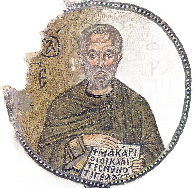
Ephrem the Syrian, mosaic in Nea Moni
Last, take it lightly, convictions differ, making things simple is not war. There is a theological intuition behind this that I have come to appreciate late, through Kees den Biesen's reading of Saint Ephrem the Syrian. As den Biesen presents him, Ephrem does not treat divine simplicity as poverty or as the absence of complication; he treats it as the unifying ground beneath the multiplicity of names, images and symbols by which the world is given to us. Simplicity, in this register, is not what remains after subtraction. It is what holds everything together.
I am no theologian, and I would not press the analogy that far. But I find it conclusive. To simplify well, I am not stripping the world down, nor restructuring its reality; I am, if I am lucky, pointing at what I would call the seam where its parts meet.
The Book of Life
My father, a university professor of "electronics and automation," and also a true polymath, and incorrigible bibliophile, always spoke to me as an upright expert, scholar and scientist. May he rest in peace! I would ask him to help me solve some mathematics problem for the next day in school; but he, the uncompromising intellectual, needed to explain first the foundation of mathematics. This is probably why I became a psychologist, an interpreter, a professional translator, a TV producer and a teacher, a management consultant and, finally, who I am now, anything but an engineer.
But he was right, making things simple has limits.
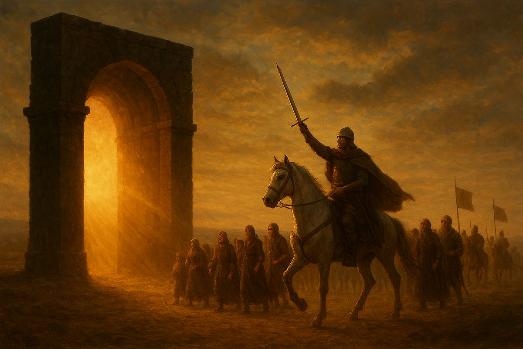
At the end of the day, making things simple is only the light cavalry preparing for the battles of knowledge.
On reflection, I wrote this essay to honour my Father; to dialogue with him once more and thus, to keep him for another instant in the Book of Life.