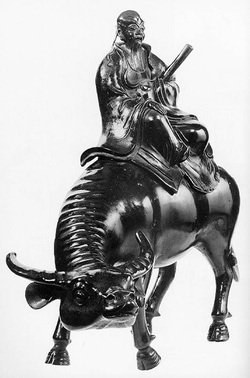
Wisdom, sleeping..
A conversation about worldly wisdom
 
Picture

We Europeans, should learn some subtlety from the Chinese before they come to teach us; Our technical culture fell into the strange belief that what we cannot grab does not count so that we can safely neglect it; even as we know well that there is more than what meets the eye.

Are we still such stuff as dreams are made on? Not anymore; we are trained with reason to sweep away everything which is not manifest, material and explicit; the non action and the absent are too elusive to be serious; as for the potential of the not yet being, it is too protean for statistics. Impressions and hunches based on lack-of-signs are baseless superstition; common-sense or good-sense about what is missing is folklore. As for imagination, it is for arts and entertainment.

This attitude is born from the faith that everything is determined by matter, by vectors...and by money; the rest - spirit, mind, feeling, memory, intuition, beliefs, dreams, will, even who we are - are mere reflections, not to be trusted.

                                                                  *

There is hope though; quality intellect can be educated to account with intangibles. We can learn from the East to be haiku poets, to use the present and the absent, the precise and the subtle, what is and what we want, at the same time – to understand, to decide and to do. This needs not remain Chinese for us.

There are alternatives to our standard model of reasoning, ways in which you acquire a rich non-linear movement of mind complementary to analysis and explication:

You emulate the understanding style of Lao Tzu, you imitate the Tao of water, you check the rules of Sun Tzu, you chance the ruses of the 36 Strategies; the same way you refine your mind with the Sufi turns of mind of Nasruddin Hodja, the myriad recipes of the folk sayings of the world, the ever-returning destinies people live according to the archetypes of the great myths, religions and masterpieces of the world literature canons.

We fill our mental coffers not only with ideas and procedures but also with forms, shapes, mental tools and choices of emotion, skill of looking and understanding, angles and points of view for looking at the World, balances for weighing the importance, the goodness lenses for beauty and ugly.

If you feel this is interesting, click here.
 
 
Picture
Thoughts which happen without effort are more often authentic, deeper and closer to life than the results of careful step by step reasoning.  

In fact, intelligence jumps and logic follows [1]. Wise thinking - the one able to behold complexity and to understand what it means for us - seems to me effortless, not belaboured.

I hurl a concern through the unconscious rich abyss of my memory and it comes back with the honey of everything I ever forgot. 

I see, grasp and suddenly I understand.

I throw a glance to an obstacle and the way around shows in a blink, if ever. 

I look back on the past, see the present, imagine what will come and shapes of the future, possible scenarios emerge and branch out in my mind, by themselves. 

I dream away with idle hands, that special mood comes, and the ripe apple of "something else" plops from the tree of Paradise, by itself.

In the end, only in the end, words fall in place - if I feel inspired - to express and to justify, more or less accurately, the living representations that grew in the mind like a tree or trickled like a rivulet.

In fact, what gives me power to foresee things other people do not consider, so that sometimes I offer valuable advice, is this: when a surprise, a problem, a crisis, an opportunity is presented, my mind starts moving spontaneously; scores of possible scenarios unfold by themselves in my imagination, exploring so many contradictory alternatives which inform me of what could occur if this or that or nothing is done. Such imprecision is much much richer and often more useful than the building of a few dry logical propositions.

                                                                   *

I let many thoughts come to me because I do not need to agree with all of them; first, I do not agree, nor disagree, just marvel and observe the thought, maybe I find something interesting; then, I judge some thoughts unacceptable or useless to me or for other people so that I oppose to them counter-thoughts or confine them to a cage in the back of my secret garden; I know, I know I should always keep a distance from the beast... but I am so weak, and live among people, the beast helps me understand the beast; finally some thoughts deserve to be grown until they bear fruit to be shared... I look at some of the fruit and I see that it is good.

                                                                 *

We are schooled to conduct the work of thinking like building domino lines, brick walls or Lego towers. Like counting prayer beads to avoid, to keep away the temptation of divergent thoughts, to be protected from our own barbarian creativity. We must sweat over artificial propositions following operations prescribed by philosophers, to give proper results, "fit to reality and to proper reasoning". We must think in words and chains of propositions; what then about thinking in sequences of image, sounds, touch, taste, relational feelings and non-verbal flows I cannot even describe in words?

Is it that people who are never inspired want us to think like them? Isn’t this effort of solemn ratiocination some kind of alien thinking with someone else’s head? [2].  It is convincingly correct, but is it real, of this world, mindsize for us? 

Nobody ever experimented logical judgments happening in a human head. We do not know today how we think in our brain, yet we try to force ourselves to advance formally, step after step, like toddlers, still led by the hand of Aristotle. Or computer-like.  This is clumsy and poor when it comes to complicated subjects and to vital ones. Many more dimensions, beneath and beyond words, vague,  volatile complexities impossible to catch by hard work of linear thought, fall in place as if at once when the mind moves freely.

Did you observe how blind can be the carefully measurable  and justified formal planning of large organizations and nations? Did you see how stupid can be the pompous arrow-like strategies sold by greedy management gurus to alibi-seeking chairmen?
                                                                  
Opposed to this, the risk-taking thinking that thinks itself seems to me richer and curiously sounder than elaborate reasoning. Provided we check it often against reality and correct it swiftly to fit the never ending flow of the river.
                                                                  *

Unfortunately, the thinking that thinks itself does so when it wants. There is no command “Be spontaneous and cast a good intuition, now!” It cannot be canned and sold like software. Who is the thinker counts too. You cannot belittle the thinker while exploiting his thinking. This is elite work for gifted people who have time to reflect or who's reasoning moves freely. Persons fed with culture and with experience.

Tversky and Kahneman's [3] considerate critique of intuitive fast-thinking is known to the connoisseur; such friendly critique (at least they look at it and see it) is welcome, while the pompous rejection of intuition creates mutual despise.  I will certainly write - if I live - about the perils of intuition and its weakness to corruption.

This miraculous flow is an artist’s work that happens when you are inspired, in a right mood; "Je ne me trouve pas où je me cherche; et je me trouve plus par rencontre que par l'inquisition de mon jugement." [4]

People who ask my advice are well advised to find me in a favourable disposition or to help me into one.
_____________________________________________________

[1] Writes Montaigne: "It should seem that the nature of wit (esprit in French - my note) is to have its operation prompt and sudden, and that of judgment to have it more deliberate and more slow." Of Quick or Slow Speech, in The Works of Michel de Montaigne, Vol. I, tr. C. Cotton, Edwin C. Hill, New York, 1910,  p. 135

[2] Schopenhauer discussed this in a very interesting essay abut reading too much instead of thinking, which, as he observes, leads to thinking with other people’s head instead of our own. Arthur Schopenhauer, The Art of Literature, (ON THINKING FOR ONESELF)

[3] Amos Tversky and Daniel Kahneman, Judgment Under Uncertainty: Heuristics and Biases, Science 185, no. 415 (1974): 1124–1131 in Kahneman Daniel, Thinking, Fast and Slow, Farrar, Straus and Giroux, new York, 2011

[4] Montaigne, Essais, NRF Bibliotheque de la Pléiade, 1933, Livre I, Du parler prompt ou tardif, p. 56
 

wisdom, criticism, losing, point of view, intuitive thinking, values, listening, silence, strategy, a time for everything, n±1, knowing people, surprise