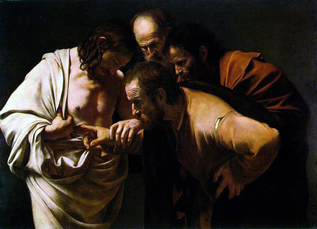
 Caravaggio, Doubting Thomas
 Critical thinking should disobey before being reasonable.
The freedom of our mind to question everything - reason included first of all - and the defying of received opinion and of face value must be unfettered before being filtered by civilised manners and censored into conformity with Method.
*
Many years ago, when I used to be a young, carefree, promising student of psychology, my Father went to see his old-time friend, the distinguished professor and academician with whom I was studying. “Is my son any good?” he inquired, “will he be a good psychologist?”
The scholar, who was an expert in animal psychology, answered with a fable-like example from the life of the bees. The kind of example used in old times to explain sex to children.
“In the morning, he said, a host of searching bees leave early to inspect the fields in search of nectar. They are dedicated, selfless, disciplined and also amazingly effective in following the memories of the hive, to inspect where are some good flowers left. As they return, they report carefully, in form of a dance and all the workers follow the recommended path for the day. All but some. There are a few bees roaming astray into unknown dangerous places. Most of them perish. But some make exception and come back with new unexpected dancing. Bees, unlike humans, trust them and follow. Those roving bees open the richest new fields. They produce change.”
The professors' flattering was undeserved but saw me right as a type; this is what I did for seventy years, unceasingly, in more than one way. Did I succeed to open new fields ? Not really, I just lived and was myself. But rich, sweet nectar I discovered, the nectar of "something else". I came upon my own head too and became who I am.
I learned that nothing new is found on the well trodden road of conformity, paved with checking forever that yes, we are right, yes, we are allowed, theory is confirmed and errors avoided, instead of seeking - as Popper advised - what will dis-confirm the received certainty. Like-minded lack of dissent is a generator of group-think and blindness. I found straying from established opinion to be a good, rewarding, useful thing to do in the mind (with prudence, of course). I found (and was later comforted by reading some great philosophers) that good, free, critical thinking is alive when driven by a ferocious curiosity to find surprise, by instinctive search for the one counter-example, for the exception that proves false the self-satisfied humming of the hive. Is this not the authentic meaning of being a seeker of truth instead of a dumb belief that we already have it?
The dawn of critical thinking is to dare to doubt (dubitare aude). To dare to seek what is not good enough. To be suspicious of the obvious and of the certain. To ask three times “Why?” - why yes and also “Why not?”
*
Those who profess that critical thinking is nothing but inspecting beliefs and arguments to be realistic and disciplined, put a yoke on their own neck and then preach freedom. A certain philosopher would say Among all of them, critical thinkers", is there one who is a critical thinker?
The difference between a critical and a complacent person is the difference between a mind still open and an already closed one.
A critical consciousness - with its intuitive movement, its common-sense judgements and, afterwards, its more orderly reasoning - tests itself and the world with no holds barred, always ready to question certainty, anew. The first instinctive move of critical awareness is not to feel self-satisfied and sufficient, to resist complacency and sway, to differ, not to conform or be awed by authority. Realism, verification and method of argumentation trot behind as a necessary second move of convincing and justification, but do not make much critical difference without the initial spontaneous move of critical initiative.
The critical thinker respects authority only on merit and accepts received knowledge and truth only after understanding it.
I claim that what is called and taught today, at the time when I write, under the ambitious and frankly false name "critical thinking" as it it were the whole process of the critical attitude at work in the world, is incomplete, only one face of the coin. We are presented with an ever better rational critique of thinking, but the other face of this Janus, critical spirit, the gadfly who starts it all, the seeker of "something else" the one prone to challenge and revise belief, is ignored, swept under the carpet.
The manuals of “critical thinking”, while teaching how to evaluate credibility and soundness of claims, by showing what is good and bad argument, also prescribe - uncritically, as if this were obvious - what truth is, what must happen in our head, what criteria to use. As if those axioms and criteria were sacred, above suspicion; but they are not. Those things are themselves subjects of critique. Such manuals are rich with procedures, algorithms, skills, logical rules and examples of fallacies, vital knowledge, but incomplete; if you just learn and follow the rules, your thinking will be utterly uncritical. I dare you that this much is not enough for critical thinking.
Yes, it is great education to learn courses and read good books of critical thinking... provided you take time to transcend all the petty little rules and procedures, and include that general culture refinement into your spontaneous flow of common-sense judgement.
To make this simple: critical thinking is in my view the one by which you have the courage, at any time needed, to draw a line and say, like one mortal living here and now: “Now I will judge for myself, with as little as I know, as reasonably as I can, and I will decide what is true for me and what not, what is good for me and what is bad, what I like and not, what I chose or reject, what to refrain from and what to do.”
*
"Something else", liberation, our own point of view, fairness, new truth, agency, life – not just sheepish imitation and copies of copies of thought - comes from discontent, first intuitive or irrational and later, hopefully, justified. Creation is life, undoing, changing, replacing. It is asking: “Why so?” and “Why not otherwise?” It certainly needs to demolish the given and requires a disorder space to turn; at least here in a sanctuary of your mind, where your freedom to swing your fist does not meet someone else’s nose.
Your critical thinking is personal. It follows your interest and intentions and is grounded by your understanding, the image in your mind, not someone else’s. It is a core part of your freedom to consider any choice of choices, to be an autonomous agent, a person starting new things. It is not neutral. We have the right to feel and to say no in our mind, long before we ground our opposition by strict argument to justify criticism with valid proofs. That will come later. Any creation, any thought of change says “no!” to what is. Or, it says “yes” to something else which is not. Not yet.
*
However, if we are not mad, we become accountable, morally and logically, for the conclusions we make ours and particularly when thoughts come out in words and deeds. When we cast our criticism among people we must be reasonable, moderate and constructive as persistently as we were anarchic inside the crucible of our mind. Often we must wisely chose to express it in veiled irony or question form. To paraphrase the common place of the notorious Dr Johnson, We may follow Fancy for our guide but must take Reason as our companion. [1]
To read the whole article click here
_____________________________
[1] The original said “We may take Fancy for a companion, but must follow Reason as our guide.” —DR. SAMUEL JOHNSON, letter to James Boswell in: Boswell James, The life of Samuel Johnson..., vol. 1, Carter, Hendee and Co, Boston, 1832
 RSS Feed