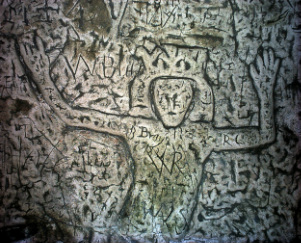
 Royston Cave, Hertfordshire cc 3.0 Cruccone 2004
 You may want to agree with the common place that the knowledge of History is a priceless treasury of sleeping wisdom, waiting to be resurrected and understood - to improve our life - instead of slowly turning to dust, forgotten in tomes nobody reads or in confidential erudition nobody listens to.
Hegel, the philosopher of grand synthesis looks at history and concludes dryly:
We learn from History that people learn nothing from History [1].
This is no news; Machiavelli observed it before Hegel: "... in the instituting of Republics, in maintaining of States, in the governing of Kingdoms, in organizing an army and conducting a war, ... there will not be found either Prince, or Republic, or Captain, or Citizen, who has recourse to the examples of the ancients. Which I am persuaded arises not so much from the weakness to which the present education has brought the world,... than from not having a real understanding of history, and from not drawing that... sense from its reading, or benefiting from the spirit which is contained in it ..." [1a]
Then, Santayana the disquiet humanist warns wisely that those who cannot remember the past are destined to relive it [2].
To this outrageous and unanimously overlooked truth, an anonymous saying appends: Wise people learn from other people’s errors [2a]; intelligent people learn from their own; fools never learn.
Are we all such hopeless fools? With so many great minds and highly educated people around, is the entirety of humanity incapable to build up such learning from experience in spite of mastering thought, language and writing? Can’t we gain some reliable wisdom from the hard-earned, blood-paid experience of the past generations? Why?*
*
We do not learn from History because we are educated from utopias and theories of how the world should be and be interpreted to be, scientifically or by dogma, instead of being presented intuitive scenes of what and how was real life, experienced by the actual people of the past; our schooling is abstract, ideology-biased and irrelevant, full of artificial, dry, high-level explanations of "processes" and "forces", with no connection to our person-size life, feelings, understanding and concerns. We learn and promptly forget century yardsticks, pompous dates of battles and opportunistic, monumental events, instead of grasping the critical events of human life that would inform our values and decisions.
We do not learn from history because we were brainwashed by Enlightenment to believe that the past is to discard, that things do not happen again, because of Progress, taking literally the abstract dictum that you will not step into the same river again. Thus we learned to believe that similar things do not happen again, when they do, so obviously in our individual life. Our Science is too busy to forecast the future so it has no time to ponder with the past.
Unfortunately, modernity's philosophers, theorists and ideologists conceived History as a necessary one-way evolution of material forces or of ideas; progress of a collective (and in-existent) colossus called "Humanity". Grand, abstract, irresistible processes in which we, individuals, play no role, except understanding explanations and serving "reality". In such history, everything did and will happen, with or without us. The locus of control (the place where important things are decided and controlled) is not inside us, but somewhere else, where we have no access. Laws of Matter, Science, Technology, History, rule as good and omnipotent as God - given fate. We, as we were schooled, are not the authors of History and therefore we are not responsible, we are powerless. "History" is not made by people, only witnessed, at best understood, explained and complied with.
In the twentieth Century class-rooms of History, the human face and the credible narrative of its witnesses were missing. We missed a way to feel that we could have been them, the ancient, individual people and groups like us... so that we - persons, communities and nations - would try to do better this time when it is our turn.
Were we to draw wisdom from the past of humanity, we would be, each of us and all together, more seasoned than Methuselah. Therefore I am puzzled by the apparent abandoning from the history books of that wise and compelling narration of concrete human experience patterns which constitutes practical wisdom.
As for the equally emancipating wide picture allowing the common individual to understand how relative are in fact some of the things taken today for granted, eternal or final, how we can change them, that scope was equally absent in the XXth Century. Only recently, Big History attempts to see the whole at galactic or planetary scope and time; unfortunately, that too belittles to naught the role of humanity and persons as compared with the billions and millions of years and cosmic infinity. Again, people are nought.
*
Beyond the backbone of facts, causalities and dates on record and the abstract interpretations, where is the flesh on the skeleton, the way people experienced and tackled the concrete events and the ever recurring seasons of change? Where is the way people lived their life, understood, willed, acted and survived (or not) the typical and critical situations of individual and collective human existence? Where are those books from the past meant to change the future?
Could we please have a Book of Witnesses?
What did actual people understand, how did they reason and do to cope with those circumstances, dangers and opportunities so characteristic and so many times repeated? What gave meaning to their lives, how did they make their life meaningful? What was happiness, success, fulfillment for them? What did they respect and value? What influence were they able to have on their condition and their future? What did they, the persons, do when they met violence, revolutions, invasion, poverty, famine, catastrophe, pestilence, terror, the unexpected newness, the rise of new civilisations and states? What choices did they have when surprised by sudden wealth or discovery, progress or aggression? Or when hit by betrayal, rejection, prejudice, decay, insecurity? How do people survive and prosper in unfree times? Which are the main mistakes people did which ruined lives so that we better know about them? What choices were found and experienced by men and women and children - or by their leaders - when meeting the long list of "historic" events and critical situations? In short what did the members of humanity learn about dealing with change?
Is it so difficult to heed Paulo Coelho's Copt, felicitously inspired by Gibran's Prophet:
"Our task is not to leave a record of what happened on this date for those who will inherit the Earth; history will take care of that. Therefore, we will speak about our daily lives, about the difficulties we have had to face. That is all the future will be interested in, because I do not believe very much will change in the next thousand years."? (2b)
Are the narrations of all that to be lost? Obsolete? Are they valueless because of not being supported by hard data fit to present-day Method?
The facts of life learned in bygone days, the ways of the world, the beliefs, the views of the World already held by those precursors, the narrations of why and how errors and successes came to be, do not get to us. This, in spite of them having been known, rehearsed and tested in real life, generation after generation. The savoir-faire, the savoir-vivre, the life-saving ideas and skills of the key situations and deeds - all those precious and meaningful patterns and insights that made lives and cost lives in other times do not seem worth to recall. The ideas of prey already proven deadly or ruinous in fallen civilisations are forgotten, prone to reappear as new. The same stupid decisions, deeds and discourses, the same dogmas and tyrannies are suffered to occur again, as if the human species were hit by amnesia or by Cassandra's curse..
Where are these costly experiences vanishing? No branch of honourable Knowledge owns them.
Wisdom extracted from the past at such a low "everyday memories" folkish, commonsense level is not considered a worthy part of the Historical Record. Is someone preserving that fount? In fact, who cares to even define luxuries like "wisdom" - that which caused flourishing and meaningful life in the past for individuals, for nations - or at least for whatever the authors believe to be prudence, civilisation, good life and "change for the better"?
The way bygone individuals carved their path into their times seems of no concern for the publicly influential writers of history. or at least I am at pains to find old narratives and reflection of this kind. We did not learn what I would call life histories - typical or exceptional - in our school years. Biographical time and narration seems too subjective and partial, of no interest for the scholars of historical time; as if they, the scholars, were amici humani generi (friends of humanity "in general") but indifferent to the living human individuals, probably too biased, who left the old testimonies. Should we count on the television series and the big-budget films to become wiser? Is this an entertainment-task to be relegated to popular literature? Or should we trust the gurus and the sects to give us the light?
I believe that opposed to this attitude of taking cold distance, History is the way we look at the past.
Even more, I think that history is the way we look at the past at the time we live, from our point of view today, with our interest; let this transformation be conscious. It is legitimate to draw and interpret from former experience hints meaningful and useful for our life now, by means of dramatic, concrete accounts, faithful to the spirit of what actually happened but presented in compelling forms of present-day common sense. Not dry smoked as dates and "data" and vectors. Rather as mind-size forms and means to re-imagine and make sense of the past. To understand and to interpret from example, we need to see and hear and feel; moreover we need to identify with those ancestors, to imagine ourselves in their stead, to relate and to understand them in the way Giambattista Vico proposed already in the Eighteens Century [2c]. I do not deny though that critical thinking and precision added would help.
Is being vivid and formative, even convincing - incompatible with serious history? Is making things simple a falsification? Are people unable to represent and conceive properly, by imagination, things done by other people? Should a reader be considered unable to judge with his own head? Must history be a dried-out grave of the ended and finished?
*
The words of Herodotus, the one who invented the very term "history" some two thousands five hundred years ago, lost their echo as it seems:
“WHAT Herodotus the Halicarnassian has learnt by inquiry is here set forth: in order that so the memory of the past may not be blotted out from among men by time, and that great and marvellous deeds done by Greeks and foreigners and especially the reason why they warred against each other may not lack renown.”[3]
The Father of history did not seem to ambition creating a new domain of academic excellence and accuracy. As it appears, he conceived history as a narrative and a morality tale for purposes of judgement and example.
Because of Herodotus’ flirting with myth, marvel and imprecision in his pursuit of the greater good, righteous Plutarch - who's Lives teach precisely what Herodotus wanted to teach - will cry out that the king is naked and the data false: “Herodotus is a father of lies!”[4] No more no less, like Satan. So, for millennia, everybody will nod approvingly, forgetting that unscientific Herodotus is still the one who introduced the very word History [3.1], and imagined its aim, the occupation of writing down the memories of the past for future generations to learn from them.
This practical purpose was simple and revolutionary, a purpose of doing something good for people: in today's wording, to make us different from all the other animals, by giving us conclusions of a wider past to own, a huge Lamarckian memory of our civilisation-driven species, allowing us to acquire and make ours the sum of what other people, previous generations, discovered in their experience; to let us learn – unlike animals – from the ancestors no more present, from former people’s mistakes and achievements. The task of the histories was clearly to avoid oblivion of wisdom hard paid, and to recount memories in such a way as to educate the living.
There are of course wonderful pragmatic books drawing risky but valuable conclusions from the past for the living person of today, I just don’t know much about them except say, some big tomes reserved to the knowing amateurs: Thucydides's Peloponesian War, Machiavelli's historical incursions, Gibbon’s History of the Decline and Fall of the Roman Empire, Durant’s Story of Civilisation, Toynbee’s Study of History or Spengler’s Decline of the West [4a]. Sombre stuff too. In fact, I learned more about past wisdom from Thomas Mann’s Joseph and his Brothers than from the history books. I can hardly imagine those tomes as an accessible public source of present-day wisdom for the common people or even for their elected governments. At this time most people show an attention span of fifteen minutes at most, then they "zap" or "click".
*
Maybe the historians, tired of repetition, do not believe any more that their role is to help the new generations avoid the notorious, disastrous, mistakes done and paid many times before, nor to profit from the always relative understanding of the past; maybe they believe that it is more important to contemplate from very high the tiny verified facts left, with a dispassionate eye. Unaltered past truth seems to be more important than influencing the future. Who would deny the virtue of a fact-based history?
Maybe the historians do not believe at all that it were their vocation to touch and improve the future, to talk to individual people, to spare individuals and nations struggling again from zero with things faced many times before by their ancestors. Are they satisfied to inquire, discern and explain causes and conditions of "necessary evolution" and leave the task of shaping the future to the inexorable progress of science and technology or even to the utopias of ideologists?
Maybe the historians do personally understand deep human truth but do not know any more how to speak with the teachers conveying their work to us or, if the teachers do not want to listen, the historians do not find the subjects and the rhetoric to move common people. Maybe convincing people seems undignified to them.
Something clips the wings of the knowing ones.
*
Maybe that which clips the wings of our great historians is, paradoxically, the noble idea of progress [5]. If progress is a necessary, upwards, one-way, from less good to better, if the future is forever new and what was will never come again, then it is indeed not worth learning from the past. Is this faith in progress more secure than other unquestioned beliefs?
Moreover, if humanity does not move ahead through the dreams and the deeds of people in flesh and bone, but through necessary processes, there is no value for us to learn from personal histories recounted. Such history would be just wild goose chase, a fool’s errand or, as a colourful Romanian proverb puts it, "amassing dead-horse-shoes." Accordingly, they let the sleeping wisdom of History sleep in peace and audit instead the authenticity of the dead horse shoes found in old strata.
It may also be that historians became shy to teach the old uncertain stories of the genre si non e vero e ben trovato,** because of their urge to be honourable scientists, reviewed and respected by their peers. They may consider and seek only certain and high-level theory-tested facts of “historic” significance. They can only represent true universal beliefs, justified by fact, based on necessary causes in objective environments, induced and deduced through impeccable methods and logical processes. Perhaps these learned people, cannot care for the practical, old, people-level recipes remembered from history, since that folkish truth is not scientific, not pure enough, not precise enough, too practical. Obviously, you cannot reproduce the narratives of history in a laboratory to test them. Or so I hope after I witnessed part of the Marxist experiment at work.
The serious historians must have found in their inner chambers that the traces of written history left to us are thin, imprecise, purposefully biased, mostly fable, cosmetic, self-serving apology by leaders who dreamt their image into posterity. Maybe they found that the most interesting memories transmitted to us from the past offer mainly deceptive and self-deceptive lies, fantasies, personal detail and wishful interpretation, no objective laws; What's the use of stories that are not even true? [6] Well, those stories transmit at least what those people were able to imagine and think.
Method detected even deadlier sins of past history writing; imagine the horror of the rational thinker when he considers scientifically the value of testimony - the narratives of other people [6a]. It is most probably scientifically correct to forget that even today, all people - you and me, including additionally the most rigorous scientists - obtain and keep obtaining the overwhelming majority of their own "justified beliefs" about the world by trust in the authority and reliability of words, of testimony and explanations from parents, teachers and preachers, of books, completed and grounded with images and sound transmitted by media known for their impartiality; only a minuscule part of what we know for certain comes from our own senses, empiric checking and from work of our personal, isolated, autonomous and critical reasoning. So that historians had to discard most of the long chains of testimonies of those eye and ear and deeds witnesses present in bygone days, when important events happened or were even initiated by them. This is a good excuse for not presenting accounts of individuals living events.
*
Maybe, besides scientific impartiality, there is too much pressure on the historian to be opportunistic, politically correct, which actual history is definitely not. Perhaps the convenient present-day meaning of the past changes too often. Indeed, I remember my late Mother, a researcher in history, saying years ago under a totalitarian regime; “The past is most difficult to foresee nowadays, as the line of the Party changes all the time.”
Or, on the contrary, the historians fell pray to the theories of "historicism" that fascinating (and discouraging) belief that everything is helplessly relative, contextual, ideological, language-based, without stable substance, changing, so that everything goes and nothing counts?
Maybe, discouraged, the historians decided that - in the same way there is no meaning or intention in the material Universe - there is no shape to find in the history of past humanity, no meaning of human life, no purpose of humankind, no regularity, nothing reoccurring so that we may learn from it? That to quote the apostle of the mass-production future H. Ford, history is bunk? [6b]
The professional study of History developed so amazingly the last century; the archaeologist keep digging into ever supplementary millions of years of our pedigree, the researchers found and checked flurries of documents. Even carbon speaks now. Concepts and methods are more and more precise.
Science keeps drilling deeper and deeper into the bottomless well of the past.
What a shame that these bright learned minds (whom I admire and respect) give us back so little! Forgive me the time-worn jest, perhaps they specialize so much that each learns more and more about less and less until they know everything about nothing or nothing about everything [7].
*
For the rest of us end-users of history the question lingers: why do so many excellent historians do so little to educate us wiser? Why is it that schoolboy Montaigne found more wisdom in Herodotus and Erasmus’s gossipy, myth-laden Apophthegms [7a] than we could learn today from the huge, sound treatises (not to speak about the boring manuals and school-lessons)? Why is past experience of people left to myths and sacred books alone?
I confess that for me, the real public benefit of history – and a vital benefit too - is Herodotus’ initial intention, to teach something meaningful from the past in order for us to do better next time we meet something similar.
*
I still have a dream that can learn wisdom from history, elusive as it is; I am not shocked by memories being most often a mixture of interpreted reality and of fable. So are some of the great works of literature and of art, fabricated to be full of human and historic truth and to generate civilisation. So are the great social theories we follow. What I seek in the history text, for myself and for the ones I want to educate with wisdom, is some coherent and understandable form and regularity, meaningful at my own level; gestalt, metaphor, comparison, striking narratives from which we can make sense and learn to live better, accounts of essence, typical of real life that was. I imagine a lay concept of “historic truth” akin to literary truth - an intelligent narration centred on that which was lived by people, that caries loyal, candid, reliable historic meaning - the deep human truth that the honest historian understood personally - at the best of his educated ability - from the many lacunar and uncertain witnessing and documents studied.
We need vivid mental treasuries that would furnish - as Montaigne dreamt - minds well made, able to judge well and exclaim “But this happened before!” instead of doing the same mistakes again as if newborn in a squirrel-cage of ever turning Samsara. People who do learn from the past may be able to prevent periodic relapse into barbarianism and cause progress - or at least defend the achieved one from foundering - instead of just suffering "change" and evolution. They may do more to avoid the decline of our "culminant" western civilisation of the day arrogant enough to believe that it saw the End of History, with nothing really new left to surprise us. This ridiculous attitude requires indeed not having learned a thing from History.
*
As a plain reader I beg you:
If Humanity saw all that before, let Humanity tell me what it means for me! For us! ... I am avid to know how past life was lived, and its vital advice for people today and tomorrow. Help me judge and chose with my own head!
*
Maybe the best historians of today would care to create – the same way some courageous scholars write of everyday private [8] and intimate [9] life across the centuries – a basic level of “life experience” historiography. They would share with us, even without Method, what they learned personally about human nature and the human condition, about critical life events and situations, to explain us what they understood from their research that what we should know to live better. We would trust their witnessing, on their word.
Can’t you historians do for people at least as much as Herodotus?
___________
* To put some water in my wine, I must concede that there may be many reasons for which we - and our governments - don't learn wisdom from history; like the pressure to live here and now and our mind’s inability to count with things out of sight, too far away or too long ago. Indeed, we hardly learn from our parents; why would we listen to people dead ages before? I only consider here one important cause, the work of the historians, as something could be done about it.
[1]Hegel, Georg Wilhelm Friedrich, The Philosophy of History, Batoche Books, Kitchener, Ontario, 2001, p.19 : "Rulers, Statesmen, Nations, are wont to be emphatically commended to the teaching which experience offers in history. But what experience and history teach is this — that peoples and governments never have learned anything from history, or acted on principles deduced from it."
[1a]"NICCOLO MACHIAVELLI, DISCOURSES Upon The First Ten (Books) of Titus Livy, To ZANOBI BUONDELMONTI AND TO COSIMO RUCELLAI, FIRST BOOK, p.3, By 1517 : "None the less in the instituting of Republics, in maintaining of States, in the governing of Kingdoms, in organizing an army and conducting a war, in (giving) judgment for Subjects, in expanding the Empire, there will not be found either Prince, or Republic, or Captain, or Citizen, who has recourse to the examples of the ancients. Which I am persuaded arises not so much from the weakness to which the present education has brought the world, or from that evil which an ambitious indolence has created in many Christian Provinces and Cities, than from not having a real understanding of history, and from not drawing that (real) sense from its reading, or benefiting from the spirit which is contained in it whence it arises that they who read take infinitely more pleasure in knowing the variety of incidents that are contained in them, without ever thinking of imitating them, believing the imitation not only difficult, but impossible: as if heaven, the sun, the elements, and men should have changed the order of their motions and power, from what they were anciently."
[2] George Santayana The Life of Reason, NEW YORK, CHARLES SCRIBNER'S SONS, 1917, p. 284:”Progress, far from consisting in change, depends on retentiveness. When change is absolute there remains no being to improve and no direction is set for possible improvement: and when experience is not retained, as among savages, infancy is perpetual. Those who cannot remember the past are condemned to repeat it.”
[2a] This part is attributed to statesman Otto von Bismarck.
[2b] Coelho, Paulo, Manuscript found in Accra : a novel, Alfred Knopf, NY 2013
[2c] Vico, Giambattista, The First New Science (1725) Tr leon Pompa, Cambridge U.P. Cambridge 2002 Read Isaia Berlin's expalnation in Vico and Herder, Two Studies in the History of Ideas, CHATTO & WINDUS, London 1980
[3] Herodotus, Book I, Loeb Classical Library 1920 p. 3
[3.1] history, n. ... Also 4 histoire, 5 hystorye, 5–6 historye, 6–7 historie.
†1.1 A relation of incidents (in early use, either true or imaginary; later only of those professedly true); a narrative, tale, story. (Oxford English Dictionary Second Edition on CD-ROM (v. 4.0) Oxford University Press 2009)
[4] Plutarch, On the Malignity of Herodotus, Moralia XI (Loeb Classical Library 426).
[4a] Pardon my ignorance. I will keep completing this superficial list.
[5] Becker Carl L., Progress and Power: Three Lectures Delivered at Stanford University, on the Raymond Fred West Memorial Foundation, April 1935. Contributors: Carl L. Becker - author. Publisher: Stanford University Press. Place of Publication: Stanford, CA. Publication Year: 1936.
** It may not be true, but it is well conceived
[6] Rushdie, Salman, Haroun and the Sea of Stories, Penguin, 1990
[6a] Kennedy, Rick, A History of Reasonableness; Testimony and Authority in the Art of Thinking, University of Rochester Press, Rochester, 2004 pp 227-255
[6b] See Corfield, Penelope J., Time and the shape of history, Yale University Press, New Haven.., 2007 - a very interesting book - for the contrary view.
[7] I wonder who said this: A physicist learns more and more about less and less, until he knows everything about nothing; whereas a philosopher learns less and less about more and more, until he knows nothing about everything. The Routledge Dictionary of Quotation (Robert Andrews) quotes Nicholas Murray Buttler 1862-1948 to have said at the Columbia University that “ An expert is one who knows more and more about less and less”
[7a] Erasmus The Apopthegmes of Erasmus, Printed by Robert Roberts, Boston Lincolnshire, 1877
[8] Ariès, P., Duby, G., Veyne, P., Goldhammer, A., History of Private Life, Vol. I-V, Belknap Press, 1992-1998
[9] Zeldin Theodore, An Intimate History of Humanity, Vintage, 1995
 RSS Feed